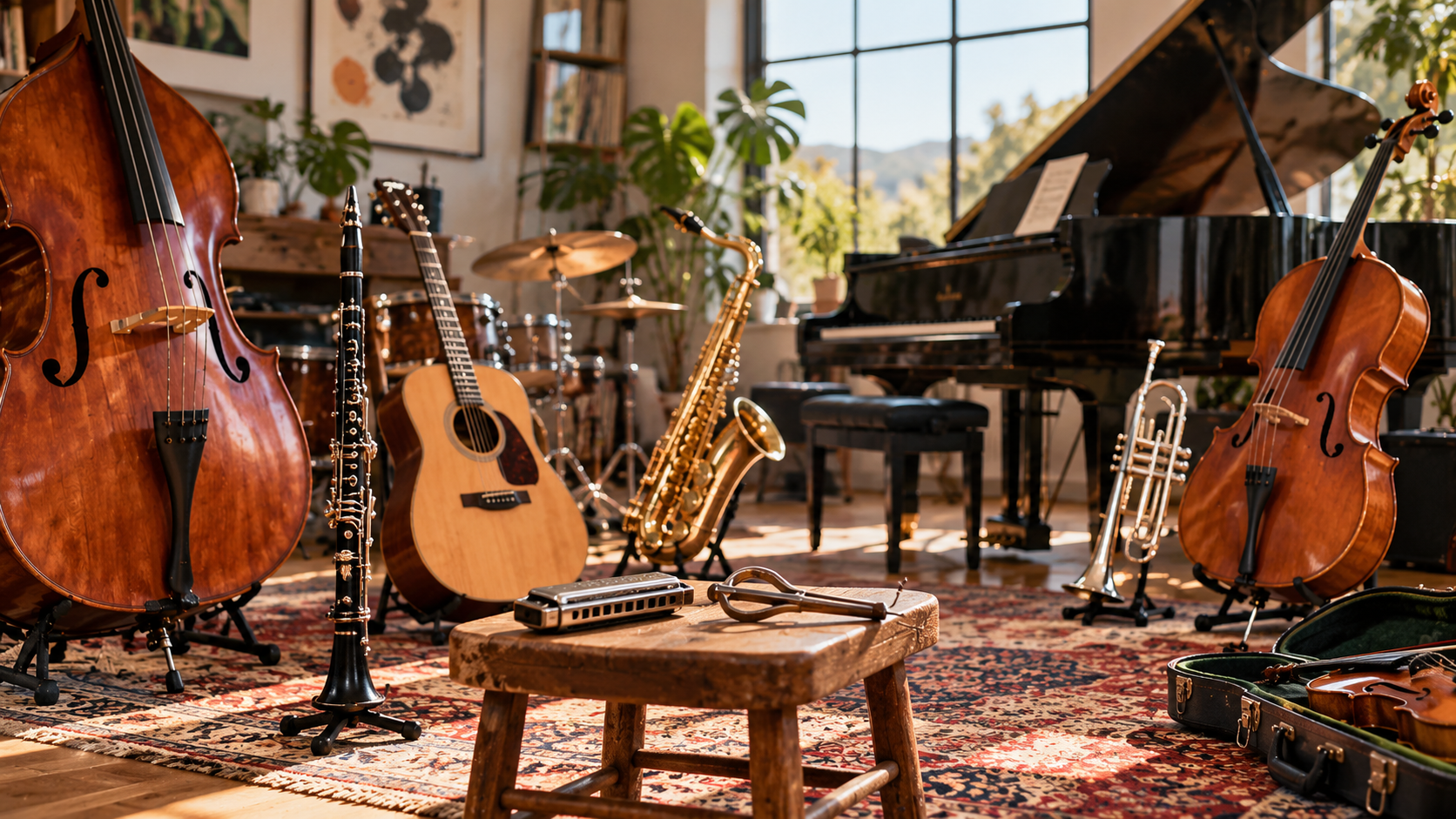
Some instruments arrive with baggage. A harmonica suggests one world, a cello another, and a jaw harp certainly comes with expectations.
Put an instrument into a music prompt and you are not just asking for a sound — you may accidentally be asking for an entire genre. That can be useful, but increasingly I like doing the opposite: taking an instrument out of the musical environment where you would normally expect to find it and seeing what happens when it has to behave somewhere else.
Keep the instrument. Lose the genre.
The trick is not simply to add something unusual. If I put a jaw harp into a song and everything around it starts sounding like folk music, the experiment has failed. The interesting part is keeping the sound while removing the musical assumptions that normally travel with it.
That became very clear while working on Planet 3: Vital Statistics. The song belongs to the world of an old scientific documentary: restrained, observational and slightly curious. Upright bass, brushed drums and acoustic piano provide most of the musical vocabulary. And then, occasionally, there is a jaw harp. On paper, it sounds ridiculous. In the track, it doesn’t. Used sparingly, it becomes a small, unfamiliar texture. It works precisely because the rest of the arrangement refuses to follow it into its usual territory.
Instruments can migrate
That made me think differently about instrumentation. Instead of asking, “What instruments belong in this kind of song?”, I can ask, “What instrument definitely does not belong here — and could I make it work?” That is a much more interesting question.
A cello does not have to announce melancholy. A clarinet does not automatically mean jazz. A saxophone does not have to drag the song towards soul. An oboe can be something other than orchestral colour. The instrument itself is only part of the equation. What it plays, how often it appears, what surrounds it and how prominently it is mixed can completely change its function.
Cross-pollination
I have started thinking of this as instrument migration, or perhaps musical cross-pollination: taking one small piece of musical DNA from somewhere else and introducing it into a different environment.
Most experiments won’t become permanent. Some immediately pull the song in the wrong direction. Others sound as though somebody added an unusual instrument merely to be clever — which is usually worse. But occasionally the foreign element stops sounding foreign and simply becomes part of the song.
Those are the ones worth keeping. Because sometimes the wrong instrument is exactly the right one.
Examples:
English horn in Roadside Diner
Cello in The Things we Tow
Jaw harp in Planet 3: Vital Statistics
Oboe in Khutulun