I only wanted somewhere to put my songs. How complicated could that be?
A home for the music
It started with a fairly reasonable idea. I was making songs, quite a few of them actually, covering everything from Belgian architects and theoretical physicists to road trips, penguins and Italian pasta shapes with unusually large personalities. They needed a home of their own.
YouTube was fine for videos, and Spotify was fine for listening, but neither was particularly good at explaining why a song existed, what went into making it, or how a Belgian architect ended up sharing a catalogue with a dancing rigatoni.
So I decided to build a website. Nothing elaborate: a few pages, some album covers, a player and perhaps a little background information. I had worked with WordPress before, so this seemed perfectly manageable.
That was the plan, anyway.
Then came the stories
The first complication was entirely predictable, at least in hindsight. CF EMCEE has always been about stories first, and the more I worked on the website, the more obvious it became that embedding a video and adding a paragraph wasn’t going to do justice to the material.
Every song had a story behind it. Some also needed an explanation of the lyrics, particularly when they involved historical references, scientific concepts or deliberate wordplay. And almost every song had its own creative history: the research, the wrong turns, the rejected musical directions, the lyric changes, the voices that didn’t quite work and the occasional version that suddenly made everything fall into place.
One paragraph therefore became three distinct sections: Story, Lyrics Explained and How It Was Made. Each needed to serve a different purpose, without repeating what had already been said elsewhere. The first introduces the subject, the second explains the words and references, and the third documents the creative decisions that shaped the finished recording.
That sounded straightforward enough, until I started writing them. It turns out that explaining how a song came into existence can be considerably more demanding than describing what the song is about.
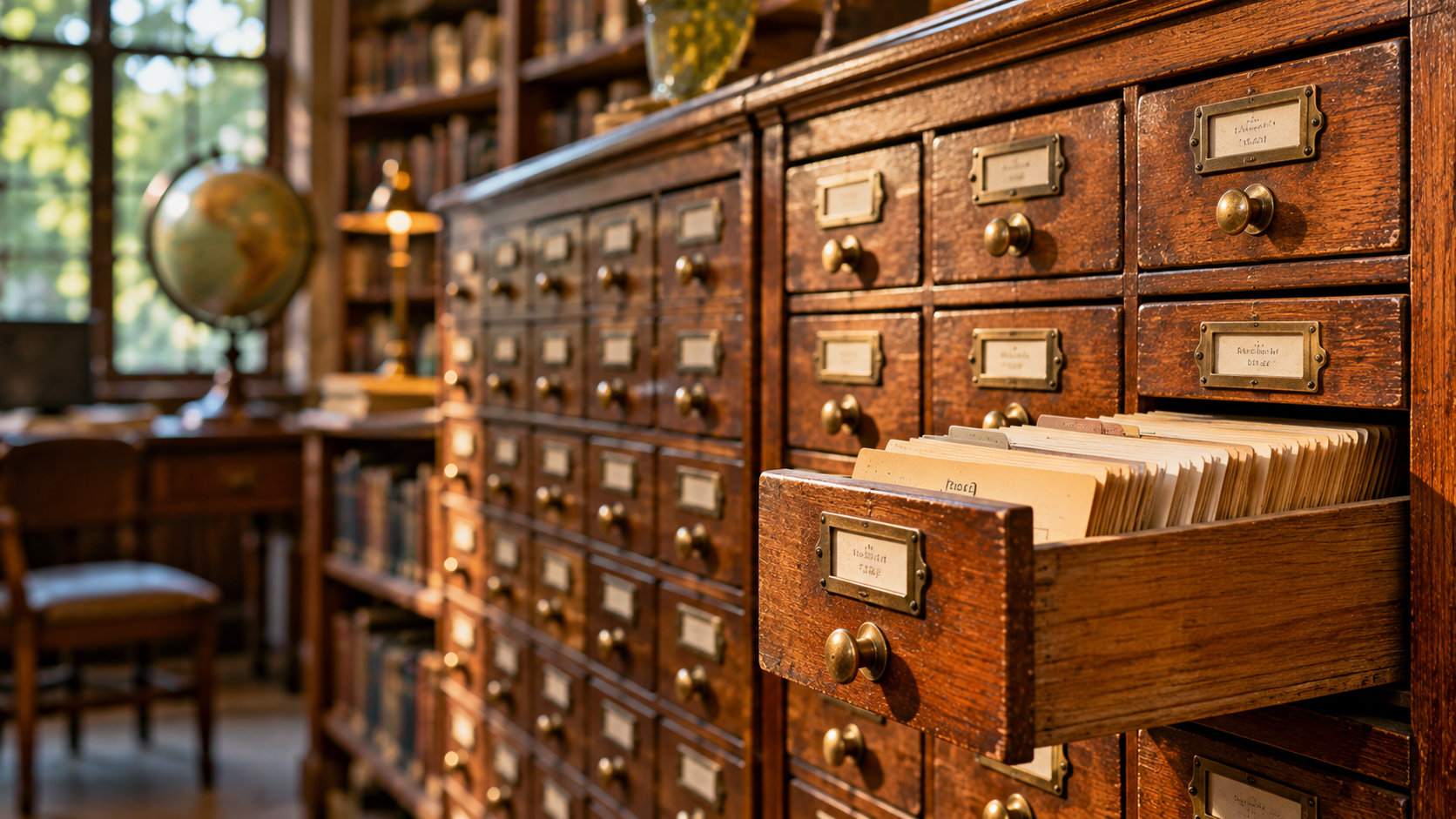
A catalogue is not just a list
Once the individual song pages began taking shape, another question emerged: how do you organise a collection of songs that have very little in common?
Albums provide a natural structure, but they only tell part of the story. Someone interested in jazz might enjoy songs from several different albums. Someone looking for science could discover Georges Lemaître alongside an atom travelling through history, while someone who particularly likes the sound of a clarinet might be interested in something entirely different.
I wanted visitors to be able to explore those connections, which meant going well beyond conventional genre labels. Gradually, each song acquired a collection of descriptive information: subjects, themes, places, moods, voices, instruments, tempo, musical influences and other characteristics. What started as a few labels developed into something I now call Song DNA.
The intention was never to turn music into a spreadsheet. It was to make the catalogue more accessible, allowing visitors to approach it from different directions and perhaps discover something they weren’t originally looking for.
I rather like the thought of someone arriving for a song about architecture and leaving with a disco track about pasta, although I accept that this may not be a particularly common journey.
And then there was WordPress
I chose WordPress because I wanted to manage the website myself, without depending on someone else whenever I needed to add a song or change a description. In principle, that should have made life easier, and for the most part it has.
The difficulty was that my requirements became increasingly specific. Songs needed to be connected to albums, albums needed to display their songs in the right order, and visitors needed to move easily between related pages. I wanted searchable metadata, combinations of filters, consistent layouts and a convenient way to edit information without constantly returning to the WordPress administration screens.
Eventually, those requirements led to a dedicated plugin called CF EMCEE Song Data, which has since been through a considerable number of revisions.
Some changes involved substantial functionality, while others concerned details that probably wouldn’t trouble a normal person for more than a few seconds. I’ve spent surprising amounts of time discussing the spacing between dropdown options, the alignment of filter controls and whether a navigation link should sit a little higher or lower.
There have also been less entertaining discoveries, such as an instrument selector that happily displayed all the available instruments but neglected to show which ones had already been assigned to a song.
None of these problems was particularly dramatic, but together they illustrated a familiar principle: the last ten percent of a project can consume a remarkably large proportion of the time.
And occasionally, while adjusting the position of a button for the third time, I remember that I was supposed to be making music.
The unexpected benefit
Somewhere along the way, I realised that the website was doing more than presenting finished songs. It was helping me understand the catalogue itself.
Writing the creative history of a song forces me to reconstruct decisions that might otherwise be forgotten. Why did I abandon that arrangement? What was wrong with the earlier chorus? Why did one voice work when several others didn’t? The finished recording rarely provides the answers, but the process of documenting it often does.
Categorising the songs has been equally revealing. It makes recurring preferences more visible, highlights connections between apparently unrelated subjects and occasionally exposes how difficult it is to describe music in a handful of neatly defined categories.
The website has therefore become something of a working archive, recording not only what I made but also why I made it that way.
This matters particularly with AI-assisted music production, where the finished audio reveals very little about the work that preceded it. The research, writing, musical direction, rejected versions and countless small decisions are largely invisible to the listener. I don’t expect everyone to be interested in those details, but I do want them to remain available.
They are part of the creative process, and I think that process deserves a place alongside the result.
Is it finished?
Almost, which in website development appears to be another way of saying not quite.
There will undoubtedly be more adjustments, additional metadata and the occasional discovery that something which worked perfectly yesterday has developed an unexpected personality overnight. I have also accepted that a website containing an expanding catalogue of songs is unlikely ever to be completely finished.
But the essential structure is now in place. The songs have a home, the albums have their own space, and the stories behind the music no longer have to disappear into old notes and forgotten conversations.
What began as a fairly modest plan to put my music online has become a way of organising, documenting and understanding the entire project. I hadn’t anticipated that the website itself would become part of the creative work, but that’s more or less what happened.
And now, if you’ll excuse me, I have a few songs to finish.
Assuming I don’t discover another dropdown that needs fixing.