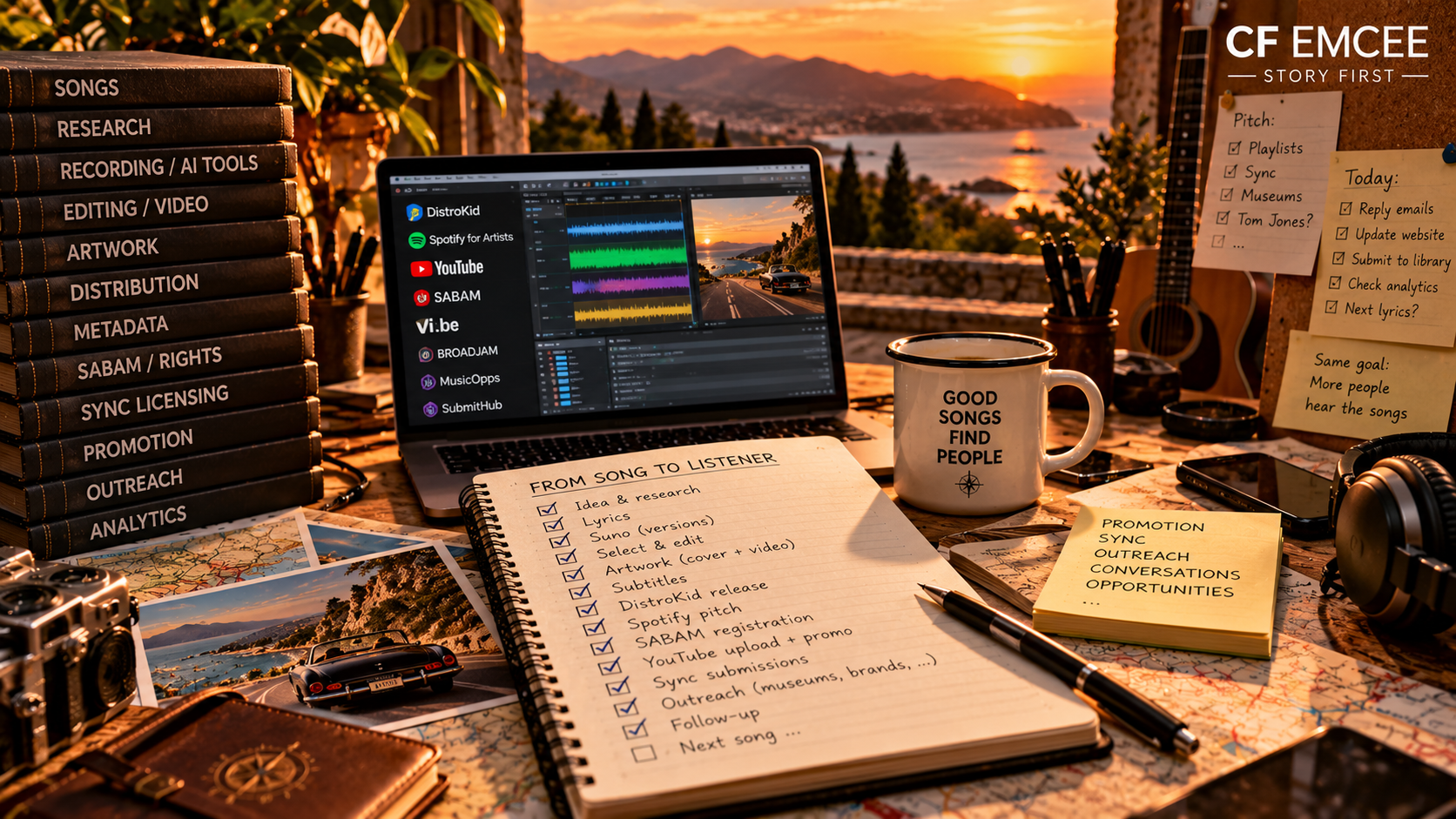
Right now, I probably spend more time administering, distributing, registering, documenting, pitching and promoting music than actually making it. Nobody mentioned that bit when I started.
Making songs is enormous fun.
Unfortunately, making songs and getting songs heard are two entirely different occupations.
Once I decided to take CF EMCEE seriously, a second job appeared almost overnight.
There are releases to distribute, metadata to maintain, artwork and videos to make, subtitles to check, songs to register, artist profiles to manage, websites to update, statistics to understand and an ever-growing collection of passwords, dashboards and acronyms.
Then comes promotion.
I pay to promote some songs on YouTube. I’m perfectly happy to say so. I’m not buying fake streams or pretending that paid discovery is organic success. I’m paying a modest amount to put a song in front of people who might genuinely be interested in hearing it.
Because uploading a song is not a promotion strategy.
There are millions of tracks competing for attention. I see little virtue in spending days or weeks making something and then expecting an algorithm to discover it through divine intervention.
But advertising is only one route.
I’ve started exploring sync licensing: finding opportunities where an existing song might genuinely fit a film, programme, shop, campaign or other use. Most submissions will lead nowhere. That’s built into the exercise. The interesting part is finding the occasional brief where I already have something that makes sense.
Then there is outreach, which may be my favourite part because it is wonderfully simple.
If I make a song about a scientist, why shouldn’t I send it to someone working in that field? If I write about an architect, why not contact the people looking after that architectural heritage?
Sometimes they don’t answer. Sometimes they politely decline.
And sometimes a conversation starts.
That alone can take a song somewhere I couldn’t possibly have planned when I made it.
The same principle applies at the more improbable end of the scale.
If I make a song and genuinely think, “I can hear Tom Jones singing this,” why wouldn’t I try to get it to Tom Jones’s management?
I don’t assume Tom Jones is waiting by the telephone for my call.
But not sending it guarantees the answer.
This doesn’t mean throwing songs indiscriminately at everyone with an email address. Outreach only makes sense when there is a real connection. Sync submissions only make sense when the song fits. Promotion only makes sense if I’m learning something from it.
There have already been rejections, unanswered messages and experiments that achieved very little. Good. That’s information too.
I’m also discovering that this side of music is bloody hard work if you’re serious about it.
And strangely, I don’t resent that.
The objective isn’t simply to accumulate streams. At this stage, I’d much rather increase the chances that the right person encounters the right song. One listener can become a subscriber. One introduction can become a conversation. One placement can expose a song to an audience I could never reach myself.
Making the song gives it existence.
The rest of the work gives it a chance.