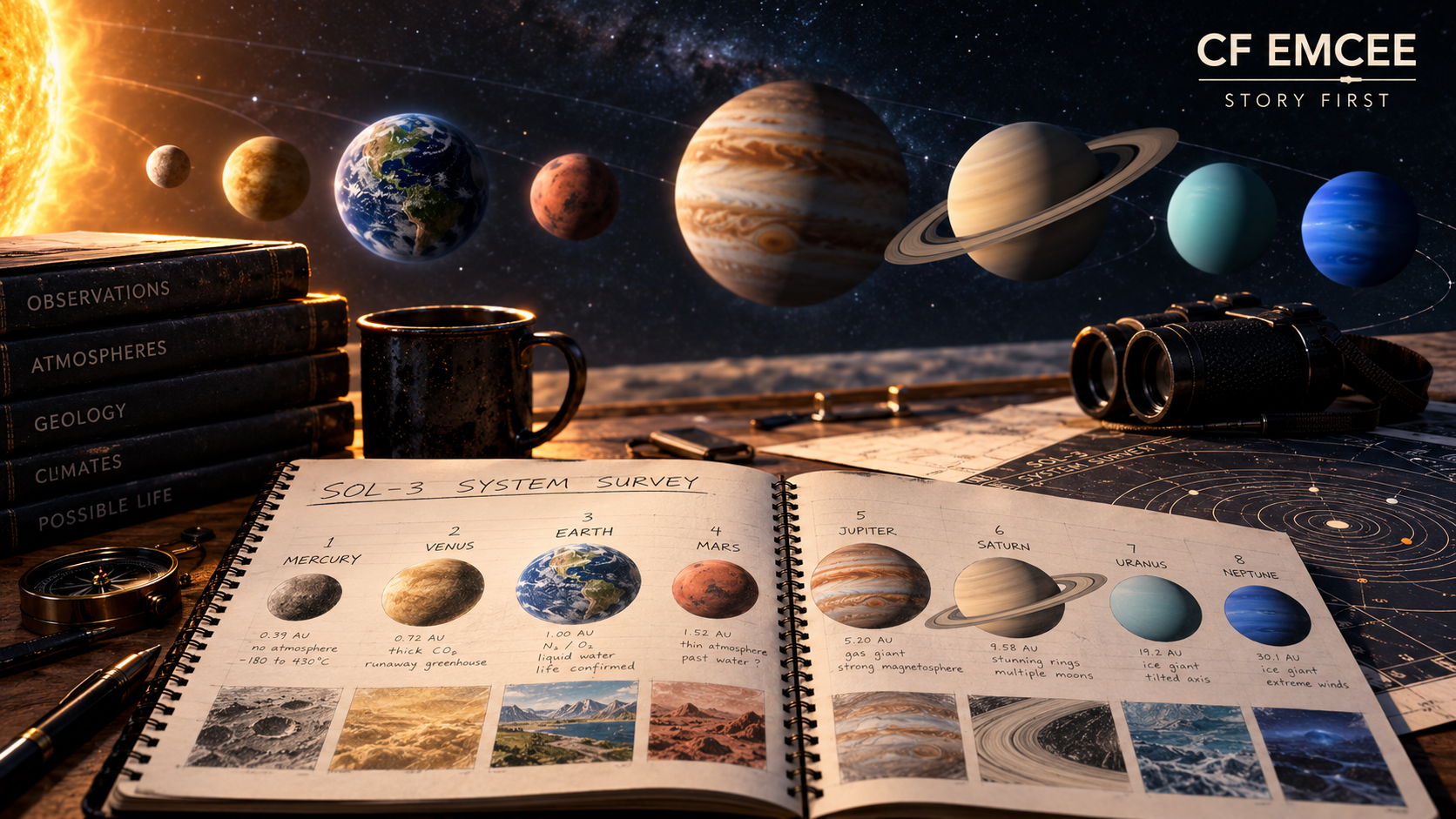
What happens when you stop treating Earth as home and start treating it as an object of study? That question gradually turned one song into a survey of an entire solar system.
The idea behind Sol-3 System Survey did not arrive fully formed.
It started with Planet 3 – Earth – but with one important restriction: I wanted to look at it from the outside. No celebration of our beautiful blue planet, no environmental sermon and, as far as possible, no assumption that humans are the centre of the story.
Instead, imagine an observer arriving in the Solar System and beginning to take notes.
The first song became Planet 3: Vital Statistics. Size, orbit, gravity, atmosphere, temperature, moons – the basic information you might collect before deciding whether a planet deserves closer inspection.
That immediately created a musical problem. Facts are useful. Lists of facts are not necessarily songs.
The solution was to treat the music almost like an old scientific documentary. The narrator isn’t trying to manufacture excitement. He observes. The arrangement stays restrained and lets the accumulation of information create the interest.
That became the sonic language of the project.
Once the vital statistics were established, looking beneath the surface seemed the obvious next step. Planet 3: The Ground became a geological survey: rocks, tectonics, water, the changing surface – and eventually evidence that something biological is happening here.
Research started shaping the writing more directly. Scientific details weren’t decoration added after the song existed. They determined where the story could go.
The production followed the same principle. The Ground settled at around 85 BPM, with a small, dry acoustic ensemble: upright bass, brushed drums, piano and restrained percussion. Even a jaw harp found its way into the final arrangement as an occasional texture – unusual enough to suggest unfamiliar territory, but never played for comedy.
There were wrong turns. Earlier versions could become too dramatic, too busy or simply too much like a conventional song about Earth. The more cinematic the music became, the less convincing the detached observer seemed.
Restraint turned out to be more interesting.
Version 5 of The Ground was the one I kept.
By then something else had happened. I was no longer thinking about a collection of songs describing Earth. The survey itself had become the concept.
If an observer is examining Planet 3, why would the investigation begin and end there?
So the project expanded. The other planets belong in the story too. Earth may eventually prove exceptionally interesting, but it doesn’t get to assume that before the evidence is in.
That change also produced the album’s new name: Sol-3 System Survey.
It’s still developing, which is part of the attraction. Each song has to work musically, but each also has a job to do in a much larger piece of fictional scientific fieldwork.
The destination is known.
The survey isn’t finished.